
Press Release: Behest Radar 1.2.2
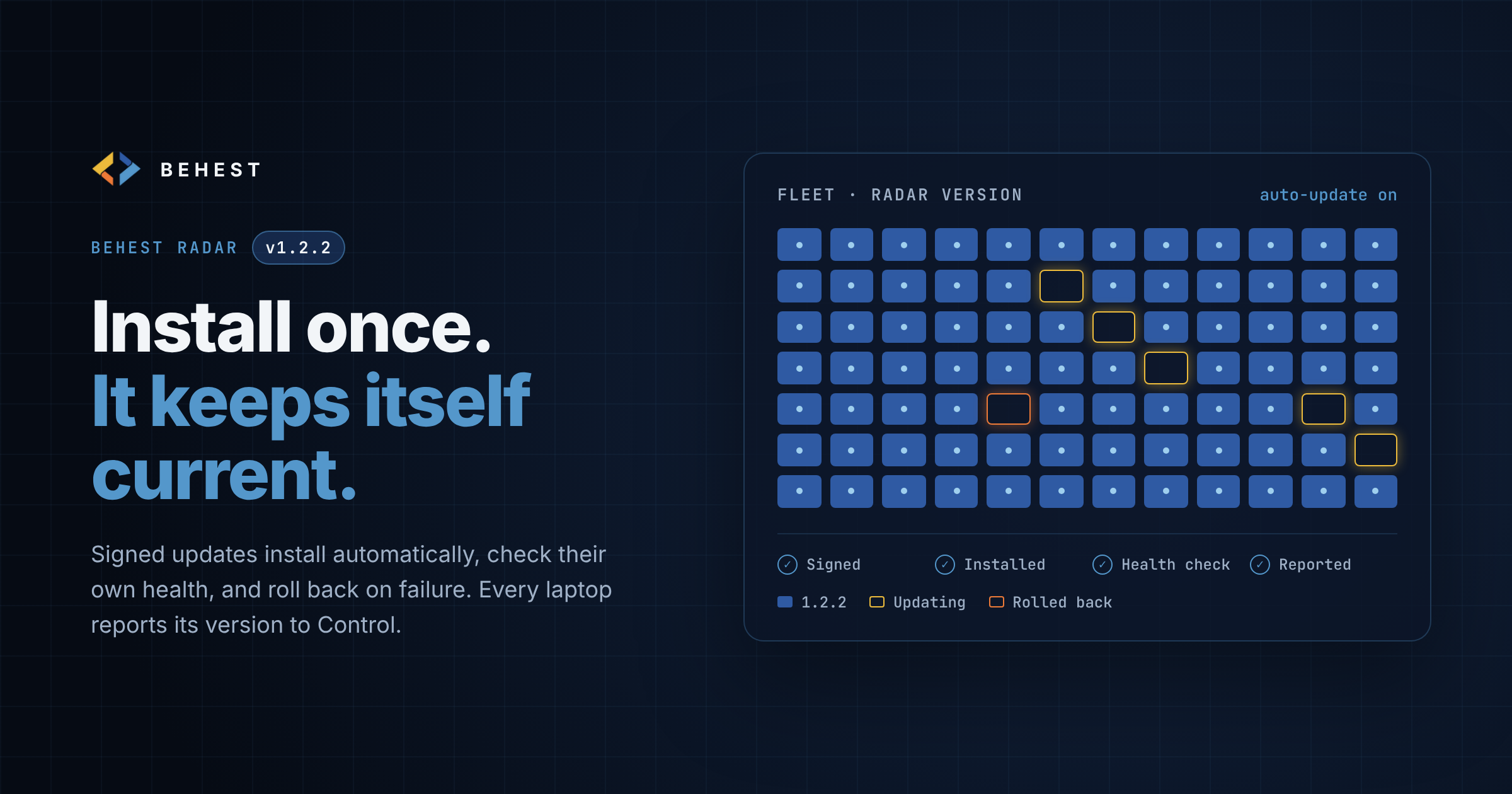
Behest Radar 1.2.2 Keeps AI Usage Visibility Current on Every Managed Laptop, Automatically
New release installs updates on its own, checks its own health, rolls back if anything looks wrong, and reports status back to Behest Control, so IT teams stop chasing endpoint versions.
CAMPBELL, Calif., Oct. 21, 2026 - Behest AI, the AI Usage Control company, today released Behest Radar 1.2.2. Radar shows enterprises what their people are actually doing with AI: which tools they use, how much, by whom and by which team, including AI tools IT never approved.
Version 1.2.2 makes Radar self-updating. Once Radar is installed on a laptop, new versions arrive on their own, verify themselves, and roll back automatically if a check fails. IT teams no longer have to repackage and push each release through their device management tool to keep a fleet current.
"Visibility only works if the agent stays current on every machine, and nobody wants to touch a policy every time we ship," said Garen Azizian, Co-Founder and CEO of Behest AI. "With 1.2.2, the security team installs Radar once and it keeps itself up to date. Engineers don't have to do a thing."
What's new in Radar 1.2.2
- Automatic updates. Radar checks for new releases and installs them in the background. Every update is code-signed and verified before it installs. No repackaging, no new device management policy, no ticket for the desktop team.
- Health check and automatic rollback. After every update, Radar confirms it is running correctly. If the check fails, it returns to the last working version on its own, so a failed update doesn't leave a laptop without coverage.
- Update status in Behest Control. Every machine reports its Radar version and update result to Behest Control, giving administrators one view of which laptops are current and which need attention.
- Installs that verify themselves. When Radar is deployed through Jamf, the install runs its own service check at the end and reports whether the machine is fully connected.
- Simpler Jamf upgrades. Updated Jamf deployment guide with a dedicated upgrade section, so teams moving from earlier Radar versions have a clear path to self-updating.
Radar 1.2.2 continues to run with no changes for engineers: no new tools to learn, no change to how they reach their AI providers.
From visibility to control
Radar is the first step in Behest's AI Usage Control platform. Organizations start by seeing what is happening: which AI tools are in use, by whom, and how much. They then find shadow AI, the tools nobody approved. When they are ready, Behest Control lets them put policies on that usage.
Availability
Behest Radar 1.2.2 is available today for macOS. Existing customers can deploy it through their current Jamf policy; once installed, future releases arrive automatically. Organizations interested in seeing what their teams are doing with AI can request a demo at behest.ai.
About Behest AI
Behest AI gives enterprises control over how their people use AI. Behest Radar shows which AI tools are in use, by whom and how much, including shadow AI. Behest Control lets organizations set policies on that usage. Behest is available as SaaS or self-hosted in the customer's own cloud. The company was founded in 2025 by security and enterprise software veterans from Palo Alto Networks, Forcepoint, Oracle and AWS, and is headquartered in Campbell, California. Learn more at behest.ai.
Media contact
Garen Azizian, Co-Founder and CEO
See it on your own numbers
Put your AI spend under control
Book a 15-minute walkthrough and see how Behest attributes, budgets, and enforces every model call — before the invoice arrives.