
Behest Ships Its AI Control Plane to Production
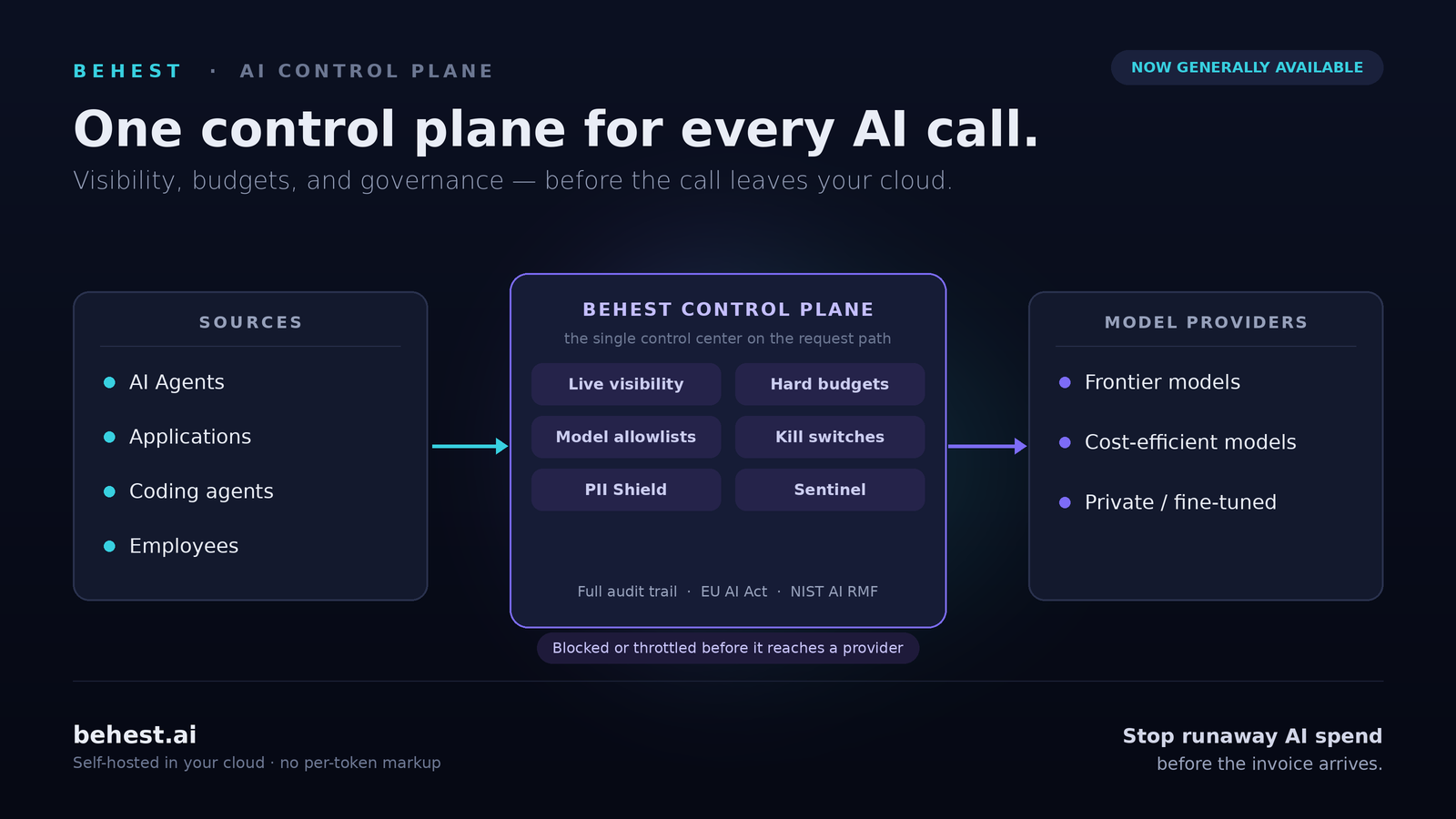
Behest Ships Its AI Control Plane to Production, Putting Budgets and Governance on Every Enterprise AI Call
As AI adoption outpaces oversight and consumption-based bills overrun budgets, Behest's self-hosted control plane brings real-time visibility, inline spend caps, and safety controls to the request path — across every model provider.
Key points
- Behest's self-hosted AI control plane is now generally available, routing every enterprise AI call — from applications, AI agents, coding agents, and employees — through a single governed request path.
- It enforces hard token budgets, kill switches, model allowlists, PII redaction, prompt-injection defense, and a full audit trail inline, before each call reaches a model provider.
- The launch lands as Gartner projects $2.59 trillion in 2026 AI spend and new Smarsh/FTI Consulting research finds only 26% of enterprises govern the AI they've already deployed.
Campbell, CA — July 12, 2026 — Behest today announced that its AI control plane is now generally available, having reached production earlier this month. The self-hosted platform routes all of an enterprise's LLM traffic — from applications, coding agents, AI agents, and individual employees — through a single control center that enforces budgets and governance inline, before each call ever reaches a model provider.
Why AI adoption is outrunning cost and governance controls
The launch arrives as the gap between how fast companies adopt AI and how well they control it draws fresh scrutiny. New research from Smarsh and FTI Consulting this month found that while 55% of enterprises have deployed AI, only 26% have the governance in place to manage it — a nearly two-to-one gap between adoption and oversight, and a widening surface for shadow AI. On the cost side, Gartner projects worldwide AI spending will reach $2.59 trillion in 2026, up 47% year over year, and consumption-based pricing has left many IT leaders facing bills they never forecast.
Even the model providers are responding. On July 2, Anthropic added administrative spend controls to Claude Enterprise. But provider-native controls stop at the edge of a single provider — and most enterprises run several, with AI traffic originating from dozens of apps and agents that no one dashboard can see.
What is an AI control plane?
An AI control plane is the single layer that every AI request passes through on its way to a model provider — the place where an organization enforces policy on the request path itself, rather than reconstructing it later from dashboards and monthly reports. Where an AI gateway (or LLM gateway) routes and proxies calls to different providers, a control plane adds the governance layer on top: visibility and attribution, hard budgets and kill switches, model allowlists, data protection, and an audit trail — all applied inline, before the call runs.
Behest is a self-hosted AI control plane and gateway for enterprises. Every request — whether it comes from a production application, a coding agent, an autonomous AI agent, or an employee — flows through Behest first.
"Every enterprise I talk to can tell you which AI models they've approved," said Garen Azizian, founder and CEO of Behest. "Almost none of them can tell you what those models are spending, or what data is going into them, until the invoice or the incident shows up. You can't budget or govern traffic you can't see. We put Behest on the request path so the visibility, the spend limits, and the safety checks all happen before the call leaves your cloud — not in a report after the fact."
What the Behest AI control plane does
Now generally available, the Behest control plane gives enterprises:
- Real-time visibility and attribution. Every call becomes a cost record the moment it completes — down to the model, tokens, cost, user, project, and session.
- Hard budgets, enforced inline. Daily and monthly caps at the global, tenant, and project level. When a cap is hit, Behest blocks or throttles before the upstream model runs — not after the invoice arrives.
- Governance on the request path. Model allowlists so only approved models run, PII Shield to scrub sensitive data before it reaches a model, and Sentinel to screen for prompt injection and abuse.
- Audit-ready evidence. A full audit trail on every call, with structured records that support EU AI Act self-classification and NIST AI RMF workflows.
- Pass-through economics. Bring your own provider keys, with no per-token markup.
This is the practical form of Token FinOps: treating the token as a unit of cost you can see, attribute, budget, and cap in real time.
Self-hosted, and built for a multi-provider world
Because Behest is self-hosted, all of this runs inside the customer's own cloud and compliance boundary. No prompts, keys, or usage data leave their environment. And because it sits in front of every provider an organization uses, one policy and one set of budgets span the entire model fleet — frontier, cost-efficient, and private fine-tuned models alike.
"The last two years were about proving AI could work. The next two are about proving you can run it responsibly — and afford it — at scale," Garen added. "Provider dashboards and end-of-month spreadsheets won't get you there. Control has to live where the traffic actually flows."
Availability and pricing
Behest is generally available today and deploys in the customer's own cloud. Pricing is a flat SaaS license with bring-your-own-key, pass-through provider costs and no per-token markup. Teams can request a demo or estimate their exposure with the free AI cost exposure calculator.
Frequently asked questions
What is an AI control plane? An AI control plane is the single layer every AI request passes through on its way to a model provider, where an organization enforces policy — visibility, spend limits, model allowlists, data protection, and audit — before the call executes. Instead of governing AI after the fact, the control plane applies rules inline, on the request path. Behest is a self-hosted AI control plane for enterprises.
How is an AI control plane different from an AI gateway? An AI gateway (or LLM gateway) routes and proxies calls to different model providers. An AI control plane adds the governance layer on top: budgets and kill switches, model allowlists, PII redaction, prompt-injection screening, and a full audit trail — enforced before each call runs. Behest combines both: it's the gateway your traffic flows through and the control plane that governs it.
How does Behest help control enterprise LLM costs? Behest turns every AI call into a cost record the moment it completes — attributed to a model, user, project, and session — and enforces hard daily and monthly budgets at the global, tenant, and project level. When a team hits its cap, Behest blocks or throttles the request before the model runs, so you stop overruns before the invoice arrives instead of reconciling them after.
Is Behest self-hosted, and does our data leave our cloud? Behest is self-hosted and deploys inside your own cloud and compliance boundary. Prompts, provider keys, and usage data stay in your environment — nothing is sent to Behest.
Does Behest work across multiple AI providers? Yes. Behest is provider-agnostic and sits in front of every model your organization uses. You bring your own provider keys with pass-through pricing and no per-token markup, so adding or switching providers doesn't change how you govern or bill AI.
How does Behest support AI governance and compliance? Behest enforces governance on the request path: model allowlists so only approved models run, PII Shield to scrub sensitive data before it reaches a model, Sentinel to screen for prompt injection and abuse, and a full audit trail on every call. The structured records support EU AI Act self-classification and NIST AI RMF workflows.
Related reading
- Token FinOps: The New Framework for Managing AI Costs at Scale
- The Token Is the New Cost Center
- AI Chargeback: Allocate LLM Costs Across Departments
About Behest
Behest is the enterprise AI Token FinOps and governance platform. Deployed in a company's own cloud (available as an option), Behest routes every AI call — from apps, agents, and employees — through a single control plane that delivers cost visibility, hard budgets, and governance before the call reaches the provider. The company's mission is to let enterprises scale AI without losing control of what it costs or how it is used. Learn more at behest.ai.
See it on your own numbers
Put your AI spend under control
Book a 15-minute walkthrough and see how Behest attributes, budgets, and enforces every model call — before the invoice arrives.