
AI Chargeback: How to Allocate LLM Costs Across Departments Without Starting a Finance War
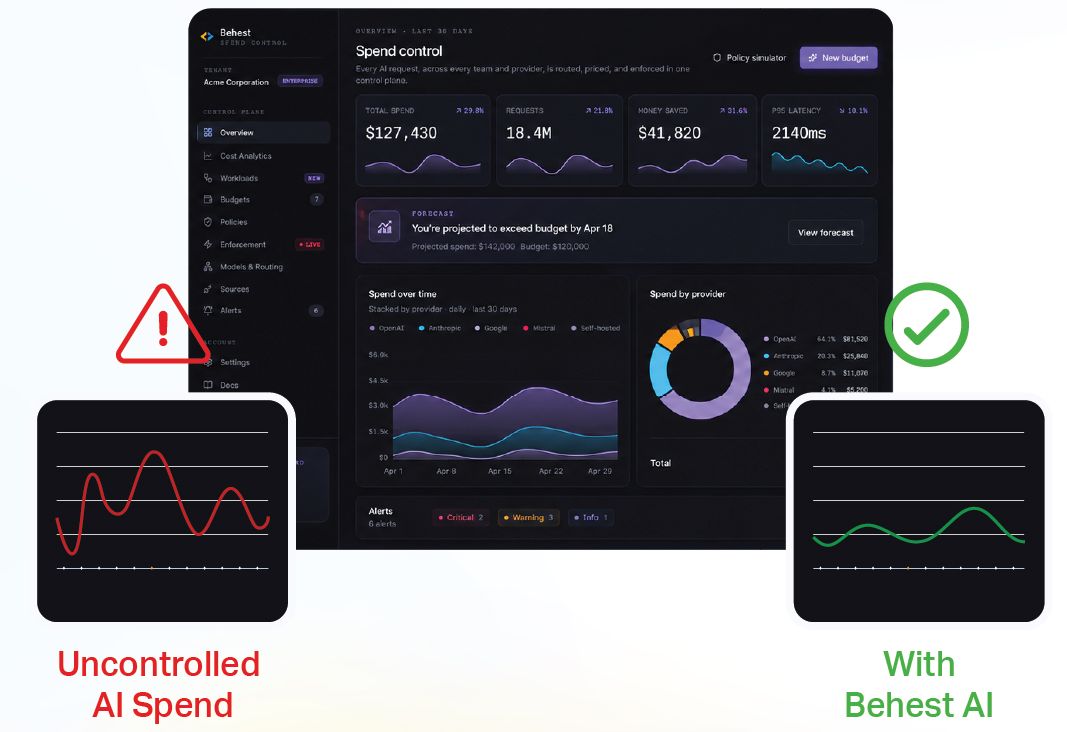
When cloud computing became mainstream, organizations faced a new challenge:
Who pays for shared infrastructure?
The answer was FinOps.
Chargeback and showback models helped organizations allocate cloud spending across departments, business units, and projects.
Today, AI is creating the same problem all over again.
Except this time, it's much harder.
A cloud server usually has a clear owner.
An AI model often doesn't.
Marketing uses it.
Engineering uses it.
Sales uses it.
Customer Success uses it.
Finance uses it.
Everyone benefits from AI.
Nobody wants the bill.
The result is a growing tension between finance teams trying to manage costs and departments trying to accelerate AI adoption.
Without a clear allocation strategy, AI spending quickly becomes one of the most politically charged items in the budget.
Why AI Chargeback Is Different From Cloud Chargeback
Traditional cloud chargeback relied on infrastructure ownership.
A Kubernetes cluster belongs to a team.
A database belongs to an application.
An AWS account belongs to a department.
AI usage doesn't follow those boundaries.
Consider a typical organization:
The sales team uses AI to generate prospecting emails.
Marketing uses AI to create campaign content.
Engineering uses AI coding assistants.
Customer Success uses AI to summarize support conversations.
Executives use AI for research and planning.
All of these activities may be consuming tokens from the same model provider account.
When the invoice arrives, finance receives one number.
Nobody knows how to distribute it fairly.
This creates the first major challenge of AI chargeback:
Shared consumption.
The Three AI Cost Allocation Models
Most organizations adopt one of three approaches.
Model 1: Corporate Cost Center
Under this model, AI spending is treated as a centralized business expense.
Finance owns the budget.
Departments use AI freely.
Advantages:
- Easy to implement
- No allocation disputes
- Encourages adoption
Disadvantages:
- No accountability
- Difficult forecasting
- Runaway spending risk
This model works for small organizations but often breaks down as AI adoption grows.
Model 2: Department Allocation
AI costs are allocated to departments based on usage.
For example:
Marketing: $8,200
Sales: $5,700
Engineering: $21,400
Customer Success: $3,900
Advantages:
- Better accountability
- More accurate budgeting
- Department ownership
Disadvantages:
- Requires reliable usage tracking
- Can create disputes over attribution
Most mid-sized organizations eventually move toward this model.
Model 3: Activity-Based Chargeback
This is the most advanced approach.
Instead of allocating costs to departments, organizations allocate costs to business activities.
Examples include:
- Cost per support ticket
- Cost per sales opportunity
- Cost per marketing campaign
- Cost per generated report
- Cost per customer onboarding workflow
This creates the strongest connection between spending and value.
It also requires the most sophisticated attribution system.
Why Most AI Chargeback Initiatives Fail
The biggest mistake organizations make is attempting chargeback before establishing visibility.
Finance creates allocation rules.
Engineering questions the numbers.
Department leaders dispute ownership.
Nobody trusts the reports.
The initiative stalls.
Successful chargeback programs follow a different sequence:
- Visibility
- Showback
- Chargeback
Not the other way around.
Step 1: Start With Showback
Before anyone receives a bill, they should receive a report.
Showback allows departments to see:
- Their usage
- Their costs
- Their trends
- Their projected spending
without being financially responsible yet.
This creates awareness without conflict.
For example:
Marketing discovers they spent $4,000 on AI-generated content.
Sales discovers they spent $2,500 on prospecting workflows.
Engineering discovers they spent $18,000 on coding assistants.
Nobody is surprised because everyone can see the data.
Only after trust is established should organizations move toward chargeback.
Step 2: Create Clear Ownership Rules
One of the fastest ways to start an internal argument is ambiguous ownership.
Organizations should establish rules such as:
- Employee usage belongs to their department.
- Product usage belongs to the product owner.
- Internal tooling belongs to the platform team.
- Shared services are allocated proportionally.
The goal is consistency.
Perfect allocation is less important than predictable allocation.
If people understand the rules, they are far more likely to accept the outcomes.
Step 3: Budget AI Like Any Other Business Function
Many organizations still treat AI spending as experimental.
That approach becomes unsustainable once spending reaches six figures.
Departments should receive:
- Monthly budgets
- Forecasts
- Spending reports
- Variance alerts
The same controls used for cloud infrastructure should eventually apply to AI consumption.
AI is no longer an experiment.
For many organizations, it's becoming a critical operating expense.
Step 4: Connect Costs to Outcomes
The most mature organizations go beyond departmental chargeback.
They ask:
What business value did this AI spend generate?
Examples:
Marketing
- Cost per content asset
Sales
- Cost per opportunity generated
Customer Success
- Cost per ticket resolved
Engineering
- Cost per pull request
At this stage, AI spending becomes measurable against business outcomes rather than simply being treated as an expense.
This is where optimization becomes possible.
Why Manual AI Chargeback Doesn't Scale
Many organizations initially attempt AI chargeback using spreadsheets.
It works for a few weeks.
Then reality arrives.
Multiple model providers.
Thousands of users.
Millions of requests.
Dozens of departments.
Hundreds of projects.
Soon the spreadsheet becomes more expensive than the AI itself.
The problem isn't calculating costs.
The problem is collecting attribution data at the moment requests occur.
Without attribution data, chargeback becomes guesswork.
How Behest Enables AI Chargeback
This is where organizations often discover they have a visibility problem rather than a budgeting problem.
To implement AI chargeback successfully, every AI request needs context.
Who made the request?
Which department owns it?
Which project generated it?
Which cost center should pay for it?
Which budget does it affect?
Behest was designed to capture exactly this information.
By operating directly within the AI request flow, Behest records usage at the user, department, project, and cost-center level before costs become invoice line items.
This enables organizations to:
- Create department-level chargeback models
- Generate showback reports automatically
- Track spending by project
- Assign ownership to every request
- Enforce budgets and spending limits
- Forecast future AI consumption
Instead of arguing about invoices after the fact, organizations can establish accountability in real time.
The Future of AI Financial Governance
Most organizations today are still focused on AI adoption.
Soon they will be focused on AI governance.
The companies that successfully scale AI will not be those with the largest budgets.
They will be the companies that understand:
- Who is spending
- Why they are spending
- What value is being created
- How spending aligns with business goals
That requires more than visibility.
It requires accountability.
And accountability begins with a chargeback model that people trust.
The challenge isn't allocating AI costs.
The challenge is allocating them fairly, transparently, and consistently.
Organizations that solve that problem will have a significant advantage as AI becomes one of the largest technology expenses of the decade.
See it on your own numbers
Put your AI spend under control
Book a 15-minute walkthrough and see how Behest attributes, budgets, and enforces every model call — before the invoice arrives.