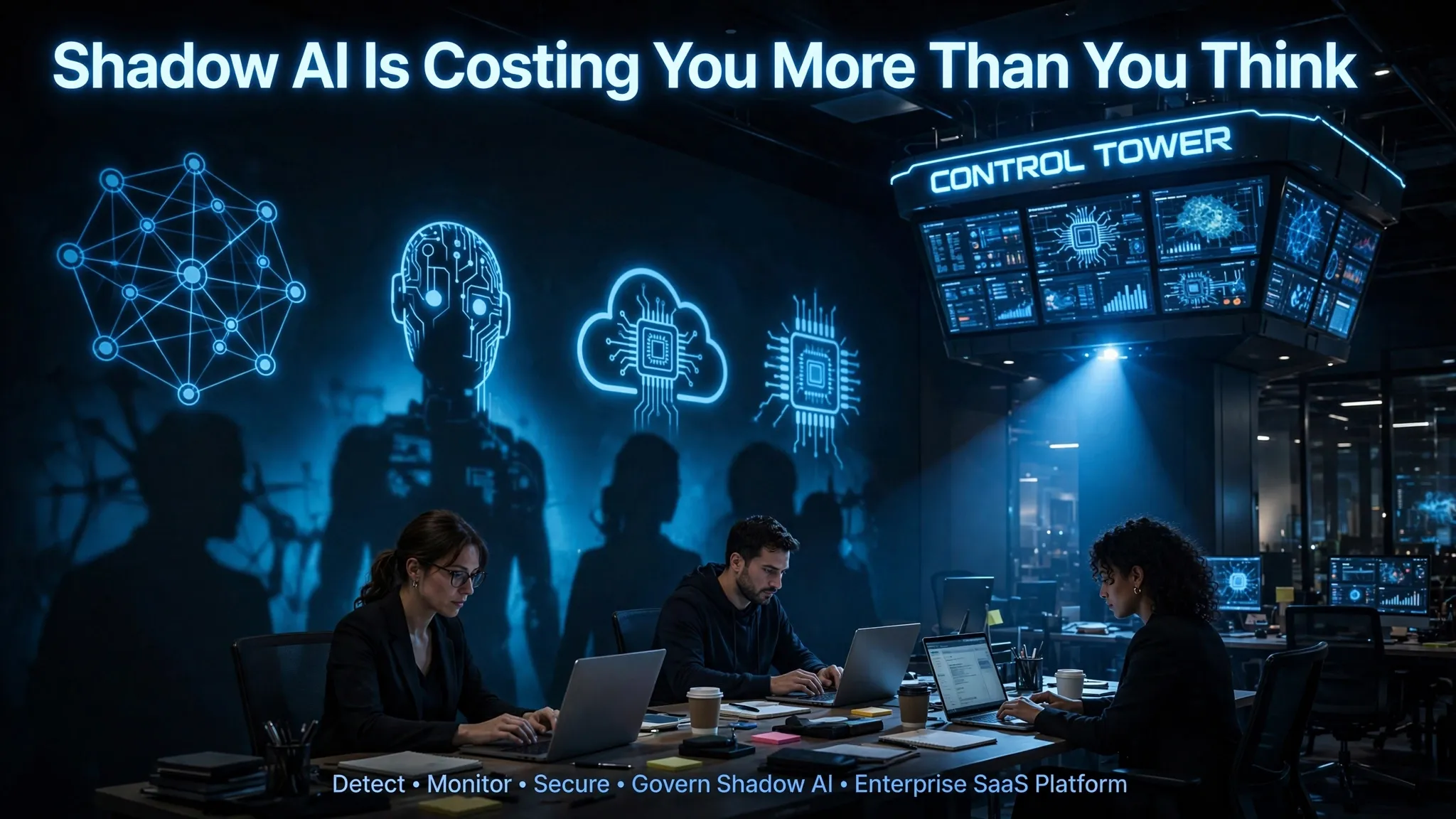
Shadow AI Cost: Find & Stop Hidden AI Spend with Behest
TL;DR:
What is shadow AI and how much does it cost? Shadow AI is unsanctioned use of AI tools and APIs by employees outside IT approval — from personal ChatGPT accounts to hardcoded API keys. The true **shadow AI cost** isn't just the direct token spend (often 2-4x your official bill), but the hidden risk: PII leakage, compliance violations, and uncontrolled data sprawl that can cost millions in breach and regulatory penalties.
Introduction
Every enterprise has an official AI stack. And then it has the real one.
An engineer hardcodes an OpenAI key into a prototype. Marketing runs customer data through a free LLM tool. A contractor pastes source code into an unauthorized chatbot. None of it shows up in your FinOps dashboard until the bill does — or worse, the breach does.
This is shadow AI, and you're already paying for it. The shadow AI cost grows as AI adoption outpaces procurement. According to the NIST AI Risk Management Framework (https://www.nist.gov/itl/ai-risk-management-framework), lack of visibility into AI systems is a core governance failure. For FinOps and security teams, it's a blind spot that breaks budgets and compliance.
You don't need another dashboard. You need control at the point of use.
What Is Shadow AI and Why Is It Spreading So Fast?
Shadow AI is any AI model, tool, or API endpoint used without central visibility, policy enforcement, or cost attribution. It's the natural evolution of shadow IT, but moving 10x faster because AI is so easy to access.
Common examples include:
- **Personal API keys:** Developers using their own OpenAI or Anthropic keys for production workloads that never get decommissioned.
- **Unauthorized SaaS:** Employees signing up for AI writing, coding, or image tools with corporate data.
- **Untracked embedding:** A team testing a feature with an LLM call that ships to production without review.
Why is it accelerating? Because the friction to use AI is zero, but the friction to get official approval is high. Developers are incentivized to ship fast. Without an invisible control layer between their apps and the AI providers, they will bypass you.
This is exactly why we built Behest (https://behest.ai/) as a drop-in control plane that sits between your applications and any LLM provider. No SDK changes, no UX changes — just governance and cost control.
How Much Does Shadow AI Really Cost Your Enterprise?
When leaders ask what is shadow AI and how much does it cost, they expect a line item. The reality is an iceberg.
1. Direct Token Waste: 2-4x Your Official Bill
Most enterprises only track the one or two corporate accounts they provisioned. Shadow usage — duplicate calls from retries, unoptimized prompts, massive context windows in dev, abandoned features still calling APIs — often exceeds official spend. Without real-time budgets per team, per user, per environment, overruns are inevitable.
2. Compliance and Data Breach Risk
This is where cost becomes material. Pasted PII, PHI, or source code into an unapproved model is exfiltration. Under the EU AI Act (https://artificialintelligenceact.eu/), failure to log and govern AI use carries penalties up to €35M or 7% of global revenue. OWASP lists sensitive disclosure and ungoverned use in its OWASP Top 10 for LLMs (https://owasp.org/www-project-top-10-for-large-language-model-applications/).
3. Zero Attribution
Without session-level attribution, you can't answer: Which team burned $12k last night? Which user pasted customer data? Provider dashboards aggregate everything. You can't optimize what you can't attribute.
How Do You Find Shadow AI Before It Becomes a Breach?
You can't govern what you can't see. Finding shadow AI requires network-level visibility, not surveys.
Step 1: Discover all egress to AI providers. Scan for direct calls to openai.com, anthropic.com, cohere.ai from outside your approved gateway. Look for high-entropy keys in repos.
Step 2: Centralize with a single control layer. Route all AI traffic through one invisible gateway. Behest runs 100% self-hosted in your own VPC via Helm, so your data never leaves your perimeter. All traffic is logged and policy-checked with sub-8ms enforcement latency.
Step 3: Enforce identity and context. Attach identity to every call. With Behest, every request gets enriched with user ID, team, project, session ID, and environment — achieving true session-level attribution. That shadow prototype suddenly becomes visible: team: growth, user: contractor_09, env: prod, cost: $847.
This is a core tenet of AI Token FinOps, detailed in our post on token FinOps for managing AI costs at scale (/blog/token-finops-new-framework-managing-ai-costs-at-scale). As outlined by FinOps.org (https://www.finops.org/framework/capabilities/), FinOps requires showback and chargeback. You can't do that for AI without session-level data.
How Do You Stop Shadow AI Cost Without Slowing Developers?
Blocking AI doesn't work. Developers route around it. Make the governed path the easiest path.
1. Real-Time Budgets and Hard Caps
Dashboards tell you that you overspent three weeks ago. Behest enforces real-time budgets with hard caps, rate limits, and quotas per team, user, and env. Hit 90%? Throttle or block — before the invoice explodes.
2. Security That Doesn't Break Flow
Behest's PII Shield redacts PII, secrets, and credentials in-flight, and Sentinel blocks prompt injection, jailbreaks, and exfiltration in real time.
3. Architecture Finance and Security Trust
Most gateways are SaaS black boxes with markup that see your prompts. Behest uses BYOK pass-through pricing (1:1 provider cost, no markup) and is self-hosted in your VPC via Helm. Complete sovereignty and audit logs. For devs, it's an endpoint swap — no UX change.
Learn how to budget before it breaks: Optimize AI Costs Before Launching (/blog/optimize-ai-costs-before-launching-behest).
From Shadow AI to Governed AI
Stopping shadow AI cost means moving from detection to prevention at wire speed.
Behest sits invisibly between your apps and providers (OpenAI, Anthropic, Bedrock, Vertex, self-hosted). Every call passes through a sub-8ms policy engine enforcing budgets, security, and compliance without developers noticing.
FAQ: Shadow AI Cost
Q1: What is the difference between shadow AI and shadow IT?
Shadow IT is unauthorized software. Shadow AI is unsanctioned LLMs, tools, and API keys. It's riskier because prompts contain code, PII, and customer data sent to third-party providers with no logging.
Q2: How do you calculate total shadow AI cost?
(Shadow token spend + SaaS AI tools) + (Engineering debug time) + (Risk-adjusted breach cost). Most find shadow token spend alone is 2-4x official bill before session-level attribution.
Q3: Can you block shadow AI without hurting productivity?
Don't block — redirect. Offer a fast, self-serve gateway easier than the bypass. With VPC-hosted BYOK and no UX change, devs get low latency and full model access; you get budgets and audit trails.
Conclusion: You Can't Cut What You Can't See
Shadow AI isn't a future risk. It's a line item on your next cloud bill and a ticket in your security queue. The total shadow AI cost is the sum of wasted tokens, invisible risk, and lost accountability.
You don't need to ban AI to control it. You need visibility at the session level, enforcement at the edge, and an architecture your CISO will approve.
Behest provides the invisible control layer that turns shadow usage into governed, attributable, and efficient AI. Self-hosted in your VPC, BYOK pass-through pricing, sub-8ms enforcement, and zero UX change for developers.
Ready to see what you're really spending on AI? Book a demo below.
See it on your own numbers
Put your AI spend under control
Book a 15-minute walkthrough and see how Behest attributes, budgets, and enforces every model call — before the invoice arrives.