
Hard Budgets for AI: Real-Time AI Budget Enforcement
TL;DR
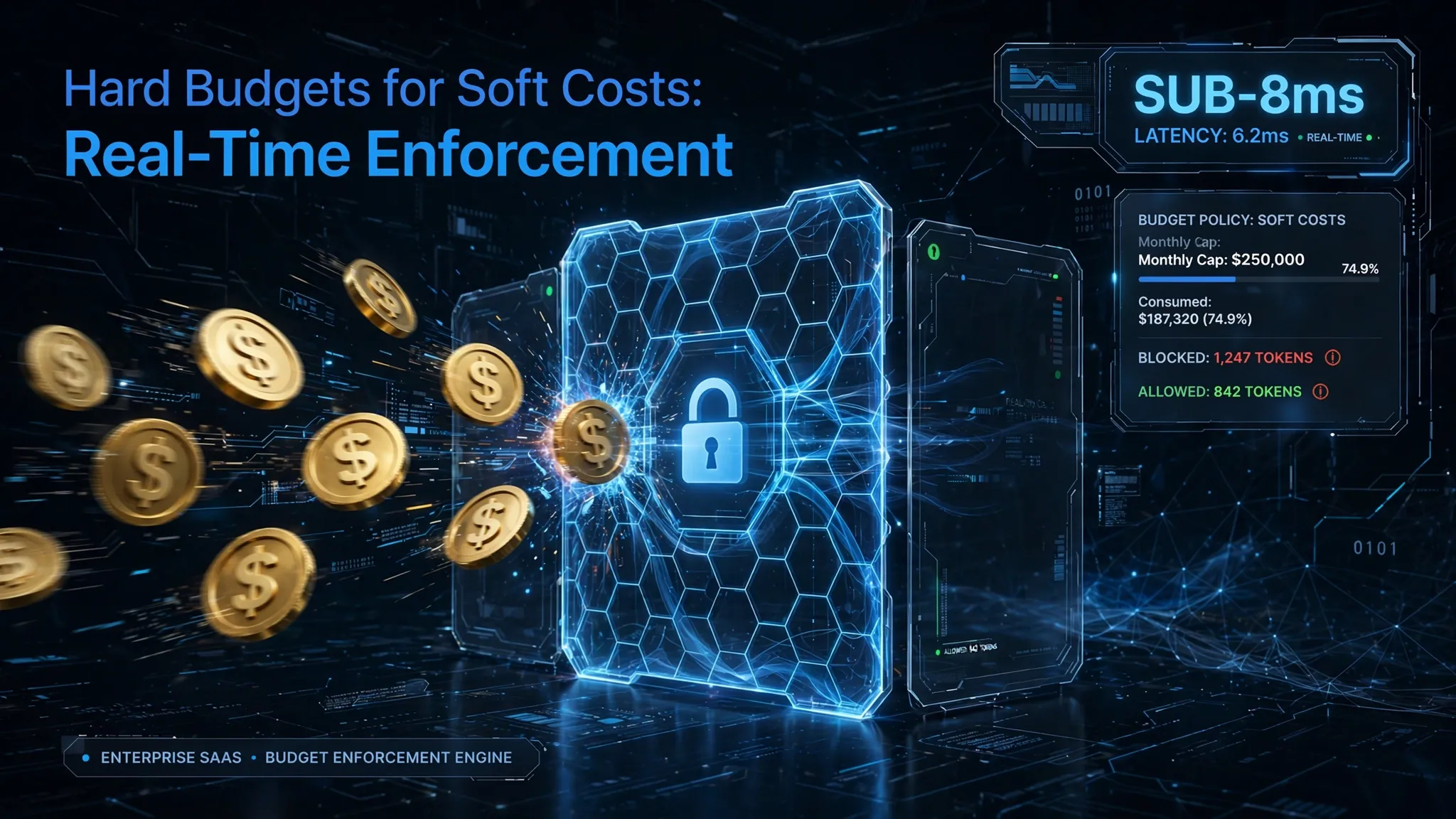
How do you enforce hard budgets on AI spend? You enforce hard budgets on AI spend by putting an invisible control layer between your apps and AI providers that tracks usage with session-level attribution and blocks, throttles, or degrades requests in real-time (<8ms) when real-time budgets are hit. Unlike monthly dashboards, true AI budget enforcement happens inline, before the provider call.
Introduction
AI costs are soft by default. Tokens, context windows, and agent loops make spend unpredictable. Most teams only discover overruns 30 days later when the provider invoice lands.
Dashboards don't stop spend. Alerts don't stop spend. Only enforcement does.
Enterprise teams are adopting AI Token FinOps to bring FinOps discipline to AI. At the center of that discipline is AI budget enforcement — the ability to define a hard cap and guarantee it is never exceeded.
Behest (https://behest.ai/) is an invisible control layer that sits between your applications and your AI providers. It enforces real-time budgets with sub-8ms latency, with no UX change for developers. Self-hosted in your VPC via Helm, with BYOK pass-through pricing, Behest gives you control without adding cost or risk.
What We Mean by Hard Budgets
A soft budget tells you that you overspent.
A hard budget prevents you from overspending.
If you can't enforce it, it's not a budget. It's a report.
How Do You Enforce Hard Budgets on AI Spend? Real-Time AI Budget Enforcement
Real enforcement must happen inline, not after the fact.
Behest deploys as an API gateway in your VPC. Every OpenAI, Anthropic, Azure OpenAI, or Bedrock call routes through it. The flow:
1. Define: Set real-time budgets by workspace, team, application, user_id, or custom tag. Example: $500/day for support bot, $5k/month for engineering, $0.10 per end-user session.
2. Attribute: Every request is enriched with session-level attribution — who made the call, which feature triggered it, which customer session it belongs to. No more untagged token blobs.
3. Evaluate in <8ms: Before proxying to the provider, Behest's policy engine checks spend against budget in memory. P95 overhead is <8ms.
4. Enforce: If budget is at 100%, you choose the action: hard block with 429, degrade to a cheaper model (GPT-4o -> GPT-4o-mini), or queue/throttle. No failed UX — just controlled cost.
This is what the FinOps Framework (https://www.finops.org/framework/) calls a FinOps control: a preventative guardrail, not detective reporting. Provider dashboards, like the OpenAI usage dashboard (https://platform.openai.com/usage), can only show you what already happened.
Result: Zero invoice surprises. Predictable burn. Finance can pre-approve AI spend because it literally cannot be exceeded.
Why Do AI Budgets Fail Without Session-Level Attribution?
You can't govern what you can't attribute.
Most gateways log model and api_key. That's useless when one key serves 10 teams and 50,000 users. When costs spike 240%, you don't know if it's a runaway agent loop, a power user, or a prompt injection attack burning context.
Behest solves this with session-level attribution:
- **Tag injection:** Automatically inject `user_id`, `session_id`, `feature`, `env`, `customer_tier` from headers or JWTs.
- **Cost allocation:** Roll up spend to the business unit that owns it for showback/chargeback.
- **Anomaly detection:** Spot when a single session consumes 100x normal tokens — a clear sign of a loop or attack.
Without this granularity, real-time budgets are impossible to set fairly. With it, you can implement true AI Token FinOps: every dollar tied to a product outcome.
Learn more about cost allocation models in our deep dive: Token FinOps: New Framework for Managing AI Costs at Scale (/blog/token-finops-new-framework-managing-ai-costs-at-scale)
What Architecture Do You Need for Enterprise-Grade Enforcement?
For regulated enterprises, enforcement can't require sending prompts or PII to a third-party SaaS.
Behest is designed as an enterprise control plane:
1. Self-Hosted in Your VPC via Helm
Installs in 15 minutes to EKS, GKE, or AKS. All inference traffic stays in your network. Data never leaves your VPC. SOC 2, HIPAA, and GDPR ready. This is critical for meeting requirements in the NIST AI Risk Management Framework (https://www.nist.gov/itl/ai-risk-management-framework).
2. BYOK Pass-Through Pricing
Behest is BYOK: Bring Your Own Key. We never mark up tokens. You pay providers directly at your negotiated rate. We charge for control, not consumption. Compare this to markup gateways that quietly add 20-40% — with BYOK, your FinOps team gets audit-ready, 1:1 cost visibility.
3. No UX Change for Builders
Developers change one line: the base_url. SDKs remain identical. No rework, no new libraries, no latency complaints. The control layer is invisible.
4. Built-In Guardrails That Save Money
Cost overruns are often security failures. Behest bundles:
- **PII Shield:** Detects and redacts PII before it hits the provider, avoiding compliance fines and unnecessary high-retention logging costs.
- **Sentinel:** Detects prompt injection, jailbreaks, and data exfiltration that can trigger massive token waste. Per the [OWASP Top 10 for LLM Applications](https://owasp.org/www-project-top-10-for-large-language-model-applications/), prompt injection is the #1 risk, and it's also a direct cost risk.
Security and FinOps are the same problem: uncontrolled inputs lead to uncontrolled costs.
See how to shift this left in your lifecycle: Optimize AI Costs Before Launching with Behest (/blog/optimize-ai-costs-before-launching-behest)
FAQ: AI Budget Enforcement
Q1: How is Behest different from native provider budgets or a cloud marketplace gateway?
Native provider budgets are soft — they alert at 80% but don't block at 100%, and they lack granular attribution. Most SaaS gateways add token markup and require you to send all prompts to their cloud, creating data risk. Behest provides hard, real-time enforcement with sub-8ms blocking, session-level attribution, and is self-hosted in your VPC via Helm with BYOK pass-through pricing, so your data and your negotiated rates stay yours.
Q2: Will hard blocking break my application UX?
No, if you configure graceful enforcement. Instead of a hard 429, you can configure Behest to automatically fall back to a cheaper model, return a cached response, or throttle by user. Most customers use degraded response for free-tier users and hard blocks only for internal sandbox API keys. Because enforcement is invisible and at the API layer, there's no UX change until you hit cap — and then it's intentional.
Q3: How do you handle long-running agents and streaming?
Behest accounts for streamed tokens in real-time. It tracks rolling token count during a stream and can cut the stream mid-generation if a budget is exceeded. For agentic loops, session-level budgets prevent runaway loops from consuming thousands of dollars in one session — something monthly billing aggregation can never catch.
Conclusion: Make Soft Costs Hard
AI spend will grow 10x in the next year. Whether it grows controllably is an architectural choice.
Stop relying on alerts to do a gateway's job. True AI budget enforcement requires inline evaluation, session-level attribution, and a hard block that executes in milliseconds — not an email 3 weeks later.
Behest is the invisible control layer between your apps and providers that makes hard budgets possible. Deployed in your VPC, with BYOK pricing, PII Shield and Sentinel for cost-related risk reduction, and zero developer friction.
Ready to move from billing surprises to enforced budgets? Book a demo below. We'll show you live sub-8ms enforcement with your own VPC deployment.
See it on your own numbers
Put your AI spend under control
Book a 15-minute walkthrough and see how Behest attributes, budgets, and enforces every model call — before the invoice arrives.