
AI Token FinOps: Why Pay-As-You-Go Frontier Models Make Cost Control Non-Negotiable
AI Token FinOps: Why Pay-As-You-Go Frontier Models Make Cost Control Non-Negotiable
TL;DR: The most capable AI models on the market are moving to metered, pay-per-token pricing with no monthly subscription that caps your spend. A flat plan limits your downside. Usage-based pricing doesn't. That makes AI Token FinOps — real-time visibility, model routing, and hard budget controls on every AI call — a requirement from day one, and not just for large enterprises. Small, fast-moving teams are the most exposed.
Not long ago, the best AI models were locked behind enterprise contracts and procurement cycles. Today you can rent frontier-class intelligence by the token. No subscription, no minimum, no sales call. A two-person startup can run the same model as a company with 10,000 employees and pay only for what it uses.
That is a genuinely good thing. It is also where the trap is hiding.
The trend: frontier AI became a metered utility
In 2026, the top tier of AI pricing quietly split in two.
Most models you use every day are still bundled into a monthly plan. GPT-5.5, Gemini 3.1 Pro, Grok 4.3, and Claude Opus 4.8 all come with your subscription. There is a ceiling: you pay your fee, you get your access.
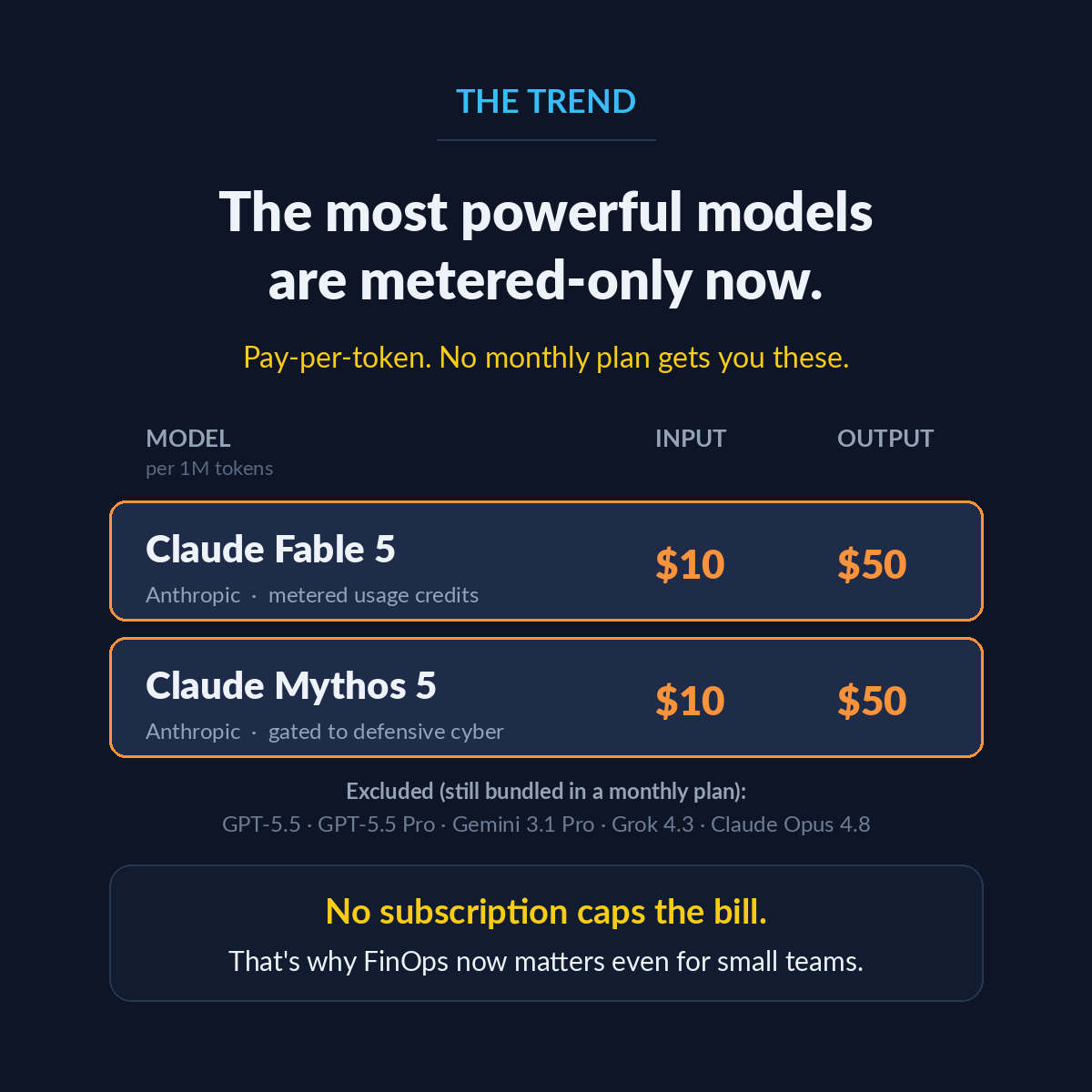
The newest, most powerful models broke that pattern. Anthropic's Claude Fable 5 launched on June 9, 2026, then moved out of subscription plans and onto metered usage credits. There is no flat plan that gets you Fable 5. You pay per token, full stop.
Frontier models available only pay-as-you-go (no subscription)
Claude Fable 5: $10 per 1M token input and $50 per 1M tokens output with Metered usage only
Claude Fable 5: $10 per 1M token input and $50 per 1M tokens output with Metered usage only with access available for defensive-cyber use
For comparison, the models that are still bundled in a monthly subscription include GPT-5.5 and GPT-5.5 Pro (ChatGPT Plus/Pro), Gemini 3.1 Pro (Google AI Pro/Ultra), Grok 4.3 (SuperGrok / X Premium+), and Claude Opus 4.8 (Claude Pro/Max). List API rates change frequently — see a current frontier-model API pricing comparison and confirm with each provider before budgeting.
The pattern is clear: the closer a model gets to the frontier, the more likely it is to be priced as a pure utility. You turn on the tap, the meter runs.
Why pay-as-you-go quietly raises your risk
Here is the part that does not show up on the pricing page.
A subscription caps your downside. Usage-based pricing does not. When there is no flat monthly fee, there is also no ceiling. One loop that runs hot, one agent stuck retrying, one prompt that ballooned to 10x the length it needed, and your bill triples while you are asleep.
This is not hypothetical. AI agents behave nothing like the software finance teams are used to budgeting for. Agents are persistent and autonomous, so a single workflow can consume 10 to 50 times the tokens of a simple query. Goldman Sachs projects total token consumption growing roughly 24x by 2030, driven by always-on agentic workloads. Gartner now forecasts global AI spending at $2.59 trillion in 2026, up 47% year over year.
The counterintuitive result: the price per token keeps falling, yet AI bills keep climbing, because usage grows faster than prices drop. Cheaper tokens, bigger invoices. We wrote about why the token is the new cost center — it behaves nothing like a CPU hour, and that is exactly why it needs its own financial discipline.
What is AI Token FinOps?
AI Token FinOps is the practice of governing AI spend at the level of the token — bringing cloud-style financial discipline (visibility, allocation, and control) to every call your organization makes to a language model. The unit of cost in this era is not a server or a seat. It is a token. That breaks the assumptions traditional cloud cost management was built on, which is why AI needs its own FinOps framework.
In practice, AI Token FinOps answers three questions at all times:
- Where is the spend going? Which team, project, agent, or user is consuming tokens, and against which model.
- Is it going to the right place? Is expensive frontier capability being used for work a cheaper model could handle just as well.
- What stops it before it hurts? Are there budgets, alerts, and kill switches that fire before the invoice, not after.
Most organizations discover they don't have an AI cost problem so much as an AI visibility problem. You can't govern — or route, or cap — spend you can't see.
Why small teams need this now, not later
AI Token FinOps used to be an enterprise concern — something only large teams with nine-figure cloud budgets thought about. Metered frontier pricing changed that overnight.
The barrier to using frontier AI just dropped to almost zero. The barrier to controlling what it costs did not move at all. If you are small and moving fast, that gap is exactly where budgets disappear: cheap to start, easy to lose track of, painful to ignore.
The good news is that the habits are simple to install while the bill is still small, and far harder to retrofit once spend is sprawling across a dozen tools. That is the whole argument for optimizing AI costs before you launch, not after.
A day-one AI Token FinOps checklist
- See it. Track token spend per project, per model, and per session — not at the end of the month when the invoice lands.
- Route it. Send routine work to cheaper models and reserve frontier models for the fraction of tasks that genuinely need them. A sensible split can cut average cost per query by more than half.
- Cap it. Set hard budgets and alerts that fire before spend crosses the line, with kill switches for runaway workloads.
- Trim it. Practice context discipline. Every token that does not improve the output is money with no return.
- Attribute it. Tie every call back to a team, project, or user, so cost has an owner and optimization has a target. This is also the foundation for AI chargeback across departments.
Cost control and governance are the same problem
Once you can see and route every AI request, something else becomes possible: governance. You cannot enforce least privilege on AI you cannot see. The same request path that lets you attribute and cap spend is where you enforce model allowlists, scrub sensitive data before it reaches a provider, defend against prompt injection, and keep an audit trail.
This is the thesis behind what we are building at Behest: an AI Token FinOps and AI Governance platform that companies deploy self-hosted, in their own cloud, to control all AI traffic across the business — every call to any provider, whether it comes from an app, a coding agent, or an individual employee. Session-level cost attribution, hard budgets and kill switches, PII Shield to redact sensitive data before the model sees it, and Sentinel to block prompt injection — all on the request path. Cost is the wedge everyone feels first. Visibility and control are what you actually get. And because pricing is pass-through with no token markup, the platform cost stays a predictable line item even as your usage grows.
The takeaway
Metered frontier models are a gift and a liability in the same package. They democratized access to the best AI on the planet, and they removed the one thing that used to protect you from a runaway bill: the subscription ceiling.
Pick your cost model before you pick your vendor. Build the visibility, routing, and budget controls in from day one. The teams that win with AI will not be the ones who picked the smartest model — they will be the ones who controlled what it costs to run it.
Written by Garen, Founder & CEO of Behest. Curious where your own exposure sits? Estimate your AI cost exposure in 2 minutes, or book a 30-minute walkthrough — no slides.
Related reading
- Token FinOps: The New Framework for Managing AI Costs at Scale
- The Token Is the New Cost Center: Why FinOps Has to Apply to AI Tokens
- Why You Need to Optimize AI Costs Before You Launch Your AI Tools
- AI Chargeback: How to Allocate LLM Costs Across Departments
- Beyond AI Usage: What Do Employees Really Use AI For?
Frequently asked questions
What does "pay-as-you-go" mean for AI models? Pay-as-you-go (metered) pricing charges you per token processed — typically a separate rate for input and output — with no monthly minimum or flat subscription. You pay only for what you use, which is cheaper for light or bursty workloads but has no built-in spending ceiling.
Which frontier AI models are only available pay-as-you-go? As of July 2026, Anthropic's top-tier "Mythos-class" models — Claude Fable 5 and Claude Mythos 5 — are metered-only at roughly $10 per million input tokens and $50 per million output tokens, with no monthly subscription that includes them. Most other flagship models (GPT-5.5, Gemini 3.1 Pro, Grok 4.3, Claude Opus 4.8) remain accessible inside a monthly plan.
What is AI Token FinOps? AI Token FinOps is the discipline of managing AI spending at the token level: real-time visibility into who is spending what, routing workloads to the most cost-appropriate model, and enforcing budgets and controls before costs spiral. It applies cloud-FinOps principles to a new unit of cost — the token.
Why do AI bills go up even when token prices fall? Because usage grows faster than prices drop. AI agents are persistent and can consume 10–50x the tokens of a simple query, and consumption is projected to grow roughly 24x by 2030. Falling per-token prices are outrun by rising volume, so total bills climb.
Do small teams and startups need AI Token FinOps? Yes. Now that frontier models are available pay-as-you-go with no subscription ceiling, small teams are among the most exposed to runaway costs. Installing visibility, model routing, and hard budget caps early is far easier than retrofitting cost control after spend has sprawled.
See it on your own numbers
Put your AI spend under control
Book a 15-minute walkthrough and see how Behest attributes, budgets, and enforces every model call — before the invoice arrives.