
What If Your AI Router Could Route by Cost and Complexity?
Key points
- Every call your apps make to an AI model is a spending decision. Most of them are made blind, with no idea what the call costs or whether it needed the model it got.
- The two signals that should decide where a call goes are the ones almost no one routes on today: the cost of the call and the complexity of the task.
- Route on both and something clean happens. Easy work flows to cheap, fast models. Hard work flows to the models worth paying for. Nobody has to choose one model and overpay on everything.
- This is not a dashboard you read next month. It is a decision made in the moment the call is sent, which is the only place it can actually change the outcome.
- The idea is simple to say and hard to build, and that gap is exactly why it is about to matter.
The most expensive habit in AI right now
Here is a pattern I keep seeing, and I bet you have it too.
A team ships an AI feature. They wire every call to the biggest, smartest model they can get, because it works and the demo is great. Then they move on. Months later, the biggest, most expensive model in the catalog is quietly answering questions that a model a tenth of the price would have answered just as well. Nobody decided that on purpose. It just calcified.
Multiply that across every feature, every agent, and every employee tool in a company, and you are not looking at a rounding error. You are looking at the default way most organizations run AI today: pay top dollar for every call, whether the call needs it or not.
We accept this because the alternative feels like work. Picking the right model per use case, keeping up as new models ship every few weeks, tuning it as your traffic shifts. Who has time? So we overpay, and we call it the cost of moving fast.
I do not think that trade lasts. And the thing that ends it is an idea simple enough to fit in a sentence.
What if routing asked two questions first?
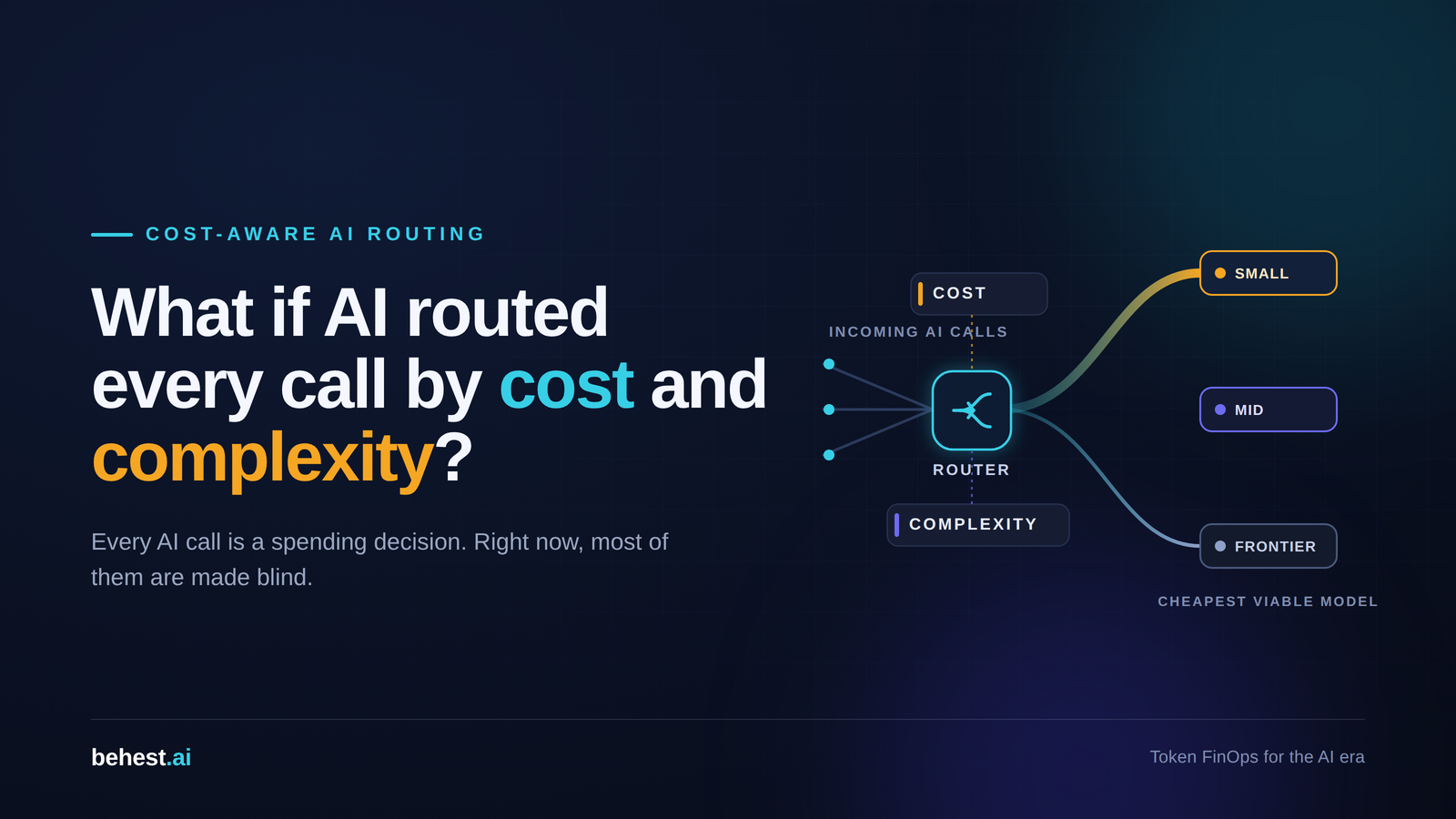
What if, before every single AI call, something quietly asked two questions: how much will this call cost, and how hard is this task? And then sent the request to the cheapest model that can still do it well?
That is the whole idea. It is called cost-aware, complexity-aware routing, and once you see it you cannot unsee it. Two signals do all the work.
Cost. Different models have wildly different per-token prices. The gap between a frontier model and a strong mid-tier one is often close to an order of magnitude. Yet the thing choosing your model usually has no idea what any call costs. It is spending real money with its eyes closed. Give it price awareness and it can finally make an economic decision instead of a habit.
Complexity. This is the signal that makes the whole thing safe. A quick classification, a short extraction, a formatting cleanup, a routine summary: none of these need a frontier model, and sending them to one is pure waste. A multi-step reasoning chain, a nuanced draft, a genuinely hard edge case: these do. Score how hard each request is, and you can reserve the expensive models for the calls that actually earn them.
Put the two together and the behavior is exactly what you would want if you sat and designed it by hand, except it happens automatically, on every call, forever. Easy work goes to cheap, fast models. Hard work goes to the models worth paying for. You stop being forced to pick one model and overpay on the easy 80 percent just to cover the hard 20 percent.
Why this has to happen in the moment, not in a report
You could try to get some of this after the fact. Pull the logs at the end of the month, find the calls that went to an oversized model, and refactor them next sprint. That is roughly how the first wave of AI cost tooling works. It watches, it charts, it tells you what already happened.
The trouble is the money is already gone by the time the chart loads. Reporting is a rear-view mirror. The decision that actually mattered, which model to call, was made and spent milliseconds ago.
That is what makes routing feel different and, honestly, exciting. It moves the decision to the one place it can change the outcome: the live moment the call is made. Not a report you read and feel bad about. A choice made correctly the first time, automatically, every time. The difference between knowing you overspent and never overspending in the first place.
The part that makes it hard, and worth it
If this were easy, it would already be everywhere. It is not, for one stubborn reason.
If something is going to sit in front of every AI call your company makes, it cannot be slow. Add real delay to every request and you have handed your users a worse product to save money behind the scenes, and they will feel it. So the entire idea lives or dies on one thing: whether the routing decision can be made fast enough that nobody notices it is there.
That is a genuinely hard engineering problem. Scoring complexity, weighing cost, and picking a model, all in the sliver of time before a call goes out, on every call, at scale. Which is exactly why it has not been a checkbox feature you could turn on years ago. And it is why the teams who crack it are going to have something the rest of the market wants.
What changes when we get this right
Play it forward. Imagine every AI call in a company routed to the model it actually needs, automatically, with no one babysitting a config.
The bill stops being a mystery. You are no longer paying frontier prices for classification tasks. Spend tracks the actual difficulty of the work you are doing, which is how it should have worked all along.
But the money is only half of it. To route on cost and complexity, every call has to flow through one place that can see it and score it. And once you can see and shape every AI call in one place, a lot of things that feel impossible today get easy: knowing which team or product is spending what, setting real limits, understanding your AI as one system instead of a hundred scattered integrations. Routing turns out to be the thing that finally gives you a handle on all of it.
That is the future I want to live in, and I do not think it is far off.
The takeaway
The question in the title is not really hypothetical. An AI router that routes on cost and complexity is buildable, the waste it removes is enormous, and the only thing standing between the idea and everyone having it is whether the decision can be made fast enough to live where the calls actually happen.
So here is the question I would leave you with. You already route your AI traffic somehow, even if that somehow is "always send it to the biggest model." So what is your routing actually optimizing for right now, and is it what you would choose if you stopped to look?
FAQ
What is cost-aware AI routing? Cost-aware AI routing is the idea of choosing the model for each request based on two live signals, the cost of the call and the complexity of the task, and sending the request to the cheapest model that can still handle it well. The decision happens per call, in the moment, rather than being hardcoded once at design time.
How is that different from how AI calls get routed today? Most setups route on a static rule someone wrote by hand, on whichever provider is fastest, or on simple load balancing. Those answer "which endpoint is available," not "which model is the cheapest one that can do this job." Cost and complexity are the two signals that actually shape your bill, and almost no one routes on them yet.
Does routing by cost mean worse answers? Not if complexity is part of the decision. Easy requests go to cheaper models and hard requests still go to strong ones, so you are matching each call to the model it needs rather than downgrading everything. The goal is to stop overpaying on easy work, not to cut quality on hard work.
Why does this have to happen on the live request path? Because that is the only moment the decision can change the outcome. Reporting tells you what you already spent; routing chooses correctly before the money is spent. It is the difference between a rear-view mirror and a steering wheel.
Why isn't everyone doing this already? Because it is hard to do fast. Anything that sits in front of every AI call has to make its decision almost instantly, or it slows down the whole product. Scoring complexity and cost that quickly, at scale, on every call, is a real engineering problem, which is why it has not been a simple switch you could flip.
How does this connect to Token FinOps? Cost-aware routing is where AI cost management stops being about reports and starts being about decisions. It is a natural next chapter for Token FinOps: instead of only measuring what your AI costs, you start shaping it at the moment each call is made.
See it on your own numbers
Put your AI spend under control
Book a 15-minute walkthrough and see how Behest attributes, budgets, and enforces every model call — before the invoice arrives.