
AI Posture: The Enterprise Blind Spot No One's Talking About
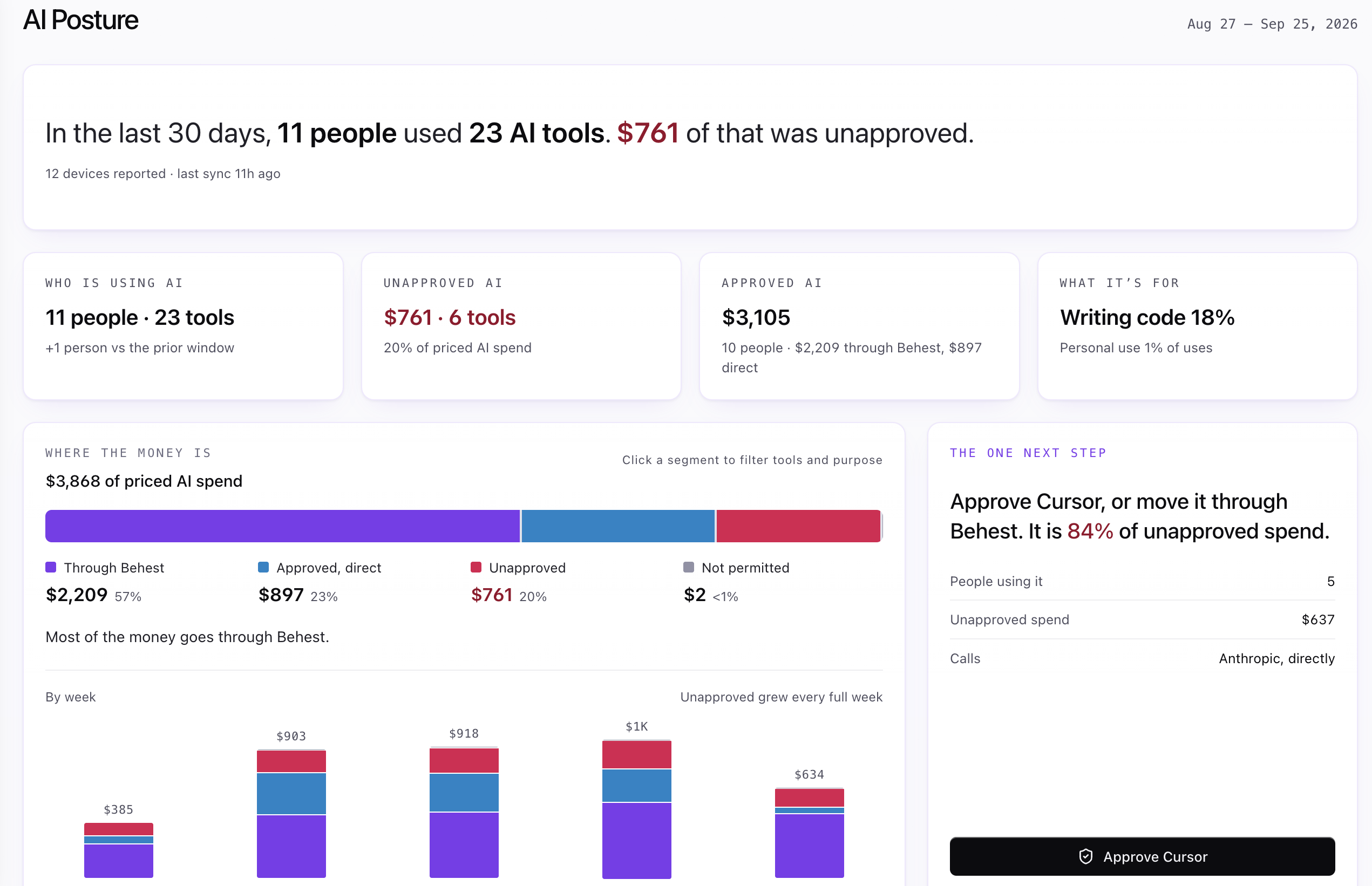
AI Posture: The Enterprise Blind Spot No One's Talking About
The term "security posture" is understood universally across enterprises. It encompasses visibility, governance, and control of your infrastructure. Every CIO knows their security posture. Every board member understands what it means.
But ask most enterprises about their AI Posture—and you'll get blank stares.
Yet for many organizations, AI is now running mission-critical workloads. Millions of dollars are flowing through large language models every month. Models are making decisions about customer service, content moderation, financial risk, and recruiting. And almost no one can accurately answer: What's our current AI posture? Where is AI being used? What's it costing? Who controls it? What happens if it goes wrong?
This is the enterprise AI blind spot.
What is AI Posture?
AI Posture is the sum of an organization's visibility, governance, and control over its AI infrastructure and usage.
It answers four fundamental questions:
- Visibility: Do you know where AI is running in your organization? Which teams, departments, and systems depend on it?
- Governance: Do you have policies, guardrails, and approval processes for AI deployment and usage?
- Cost Control: Can you track, allocate, and optimize AI spending across your organization?
- Risk Management: Do you have controls to prevent misuse, unauthorized deployments, or policy violations?
Most enterprises score poorly on all four fronts.
In reality, AI posture looks like this:
- Engineering teams spinning up AI features without approval from central IT
- Shadow AI spending scattered across departmental budgets—often hidden
- Models running in production with no audit trail or governance framework
- Zero insight into who's using which models, how, or why
- Compliance and risk teams flying blind when audits happen
This isn't because enterprises don't care. It's because until recently, AI was an experiment—a "nice to have" layer on top of traditional infrastructure. Now it's critical infrastructure. And the governance model hasn't caught up.
What AI Posture Should Be
Strong AI Posture means three things:
1. Radical Visibility
You should know every instance of AI in your organization. Every model. Every API call. Every token spent. This isn't surveillance—it's basic operational knowledge.
Just like you know which databases are running in your data center, you should know which models are running in your business. This visibility should be:
- Automatic (discovered, not manually reported)
- Real-time (updated as AI usage happens, not quarterly)
- Comprehensive (covers all models, all deployment patterns, all users)
2. Intelligent Governance
Visibility without governance is just information. Strong AI Posture includes guardrails that are:
- Invisible to users (governance that works without changing how teams work)
- Policy-driven (enforced rules, not suggestions)
- Dynamic (able to adapt to new risks and requirements without redeploying infrastructure)
This means:
- Automatically approving low-risk AI usage while flagging anomalies
- Enforcing compliance policies at the point of use
- Preventing unauthorized model deployments without slowing down innovation
- Enabling rollback or override when governance detects problems
3. True Cost Control
Every dollar spent on AI should be:
- Visible to budget holders
- Optimizable without lifting and shifting workloads
- Allocated to the teams and projects that benefit from it
This isn't about cost-cutting. It's about economic visibility. Teams that can see the cost of their AI choices make better ones.
The Problem: AI Posture is Hard
Why do so few enterprises have mature AI Posture?
The infrastructure problem: AI isn't deployed like traditional software. Teams use:
- SaaS APIs (OpenAI, Anthropic, Google)
- Managed services (Azure OpenAI, AWS Bedrock)
- Self-hosted models (on Kubernetes, on-prem, in VPCs)
- Third-party applications with embedded AI (Salesforce Einstein, Microsoft Copilot)
Visibility across all these deployment patterns requires reimagining how you instrument your infrastructure.
The governance problem: Most enterprises try to govern AI like they governed software. You ship code, it goes through approval gates, it deploys. But AI is more like runtime operations—it's dynamic, it scales unpredictably, and policies need to evolve constantly.
The "nothing changes" requirement: You can't ask every team to report their AI usage manually. You can't require redeployment or refactoring. The governance system has to work invisibly, fitting into existing workflows.
This is why most enterprises have weak AI Posture. The traditional approaches don't work at the speed and scale of AI adoption.
How to Build Real AI Posture
Mature AI Posture requires three capabilities:
1. Zero-Touch Discovery (Radar)
Your governance system needs to automatically detect AI usage across your entire infrastructure—without requiring teams to integrate, refactor, or report anything.
This means:
- Discovering AI API calls in real-time (through network observation, API gateways, or agent-based instrumentation)
- Inferring usage patterns, costs, and risk signals from that data
- Building a living inventory of AI usage that updates as your infrastructure changes
- Working alongside existing security and observability tools, not replacing them
The key: Teams shouldn't have to do anything differently.
2. Intelligent Enforcement (Control)
Once you have visibility, you need a control plane that can enforce governance policies without administrative overhead.
This means:
- Setting policies once (by role, department, cost threshold, model type, use case)
- Automatically enforcing those policies at the point of AI usage
- Enabling guardrails that adapt in real-time (throttling, approval requirements, cost notifications)
- Allowing exceptions and overrides when necessary—with audit trails
The key: Governance that feels invisible to users.
3. Operational Intelligence
Data without insight is just noise. You need:
- Cost allocation models that map AI spending to business outcomes
- Anomaly detection that surfaces risks before they become problems
- Trend analysis that shows where AI adoption is accelerating
- Compliance reports that feed into audit and risk workflows
Why Most Enterprises Will Fail at AI Posture
I'll be direct: most enterprises will have weak AI Posture for the next 2-3 years. Here's why:
- Complexity underestimated: The infrastructure is fragmented. The governance models don't exist yet. The tools don't talk to each other.
- Wrong team ownership: Too often, AI governance gets assigned to security or compliance teams who didn't design the AI strategy. This creates friction, not governance.
- Legacy processes: Enterprises try to apply software governance to AI, which doesn't work. Policies need to be adaptive, not static.
- "It's too early": Many enterprises believe they don't need AI governance yet because AI adoption is still early. This is backwards. The time to build governance is when adoption is still manageable—not after it's out of control.
The enterprises that will win are the ones that build AI Posture early. They'll have visibility when it matters most. They'll be able to scale AI with confidence. And when regulators demand AI governance frameworks, they'll have them.
The Path Forward: Behest Radar and Control
Building real AI Posture requires:
Behest Radar handles the hardest part: discovery and visibility. Radar automatically detects AI usage across your infrastructure—API calls, model deployments, internal tools—without requiring teams to integrate or report anything. It works through:
- Network observation (detecting AI API calls in real-time)
- Zero-authority re-entry (gathering usage data without requiring infrastructure changes)
- Automatic inventory building (maintaining a living map of AI usage and costs)
Radar answers the baseline question: What's actually happening with AI in our organization?
Behest Control layers governance on top of that visibility. Control enables:
- Policy-driven guardrails (approve or block AI usage based on rules you define)
- Real-time enforcement (policies work at the point of decision, not in retrospect)
- Intelligent routing (flagging high-risk usage while auto-approving low-risk ones)
- Compliance integration (feeding governance data into audit and risk workflows)
Control answers the operational question: How do we keep AI usage aligned with our policies while enabling innovation?
Together, Radar and Control give you authentic AI Posture. Not surveillance. Not lock-down. Not bureaucracy. Just:
- You know what's happening. (Radar)
- You can shape how it happens. (Control)
- Your teams can still move fast. (Both work invisibly)
The AI Posture Maturity Model
If you're building AI Posture, here's how to think about maturity:
Level 1 - No Visibility: "We're using AI, but we don't know where or how much we're spending." (Most enterprises are here.)
Level 2 - Manual Reporting: "Teams self-report their AI usage. We track it in a spreadsheet." (Brittle. Incomplete.)
Level 3 - Partial Automation: "We have visibility into some AI usage (cloud APIs, maybe). We still have blind spots." (Common for enterprises with strong cloud governance but no on-prem visibility.)
Level 4 - Comprehensive Visibility: "We see all AI usage across all deployment models. We track costs, usage patterns, and risk signals in real-time." (Rare. This is where Radar gets you.)
Level 5 - Policy-Driven Control: "We have automated governance policies. Teams know what's approved and what's blocked. Policy violations are caught before they reach production. We can trace every AI decision for compliance." (The goal. This is where Radar + Control lands you.)
Most enterprises should be aiming for Level 4 immediately, then moving to Level 5 within 12 months.
The Hard Truth
AI Posture won't be a checkbox you tick. It's a capability you build and maintain, like security posture or operational resilience.
But here's the opportunity: enterprises that move fast on AI Posture will have a massive advantage. They'll:
- Scale AI adoption with confidence
- Catch risks and policy violations before they blow up
- Make smarter economic decisions about AI investment
- Be audit-ready when regulations tighten
- Empower their teams to innovate faster
The enterprises that ignore AI Posture will face a reckoning in 18-24 months. They'll have significant AI usage but no idea what it's costing, no governance in place, and no way to defend their practices in an audit.
The time to build AI Posture is now. Not when it's urgent. Not when the board demands it. Now, while you can still build it thoughtfully.
Ready to assess your AI Posture? Learn how Behest Radar and Control help enterprises build visibility and governance at scale.
The future belongs to enterprises that see clearly and move confidently. Make sure you are one of them.
See it on your own numbers
Put your AI spend under control
Book a 15-minute walkthrough and see how Behest attributes, budgets, and enforces every model call — before the invoice arrives.