
Token Reselling Is Not SaaS — What a True AI Backend Looks Like
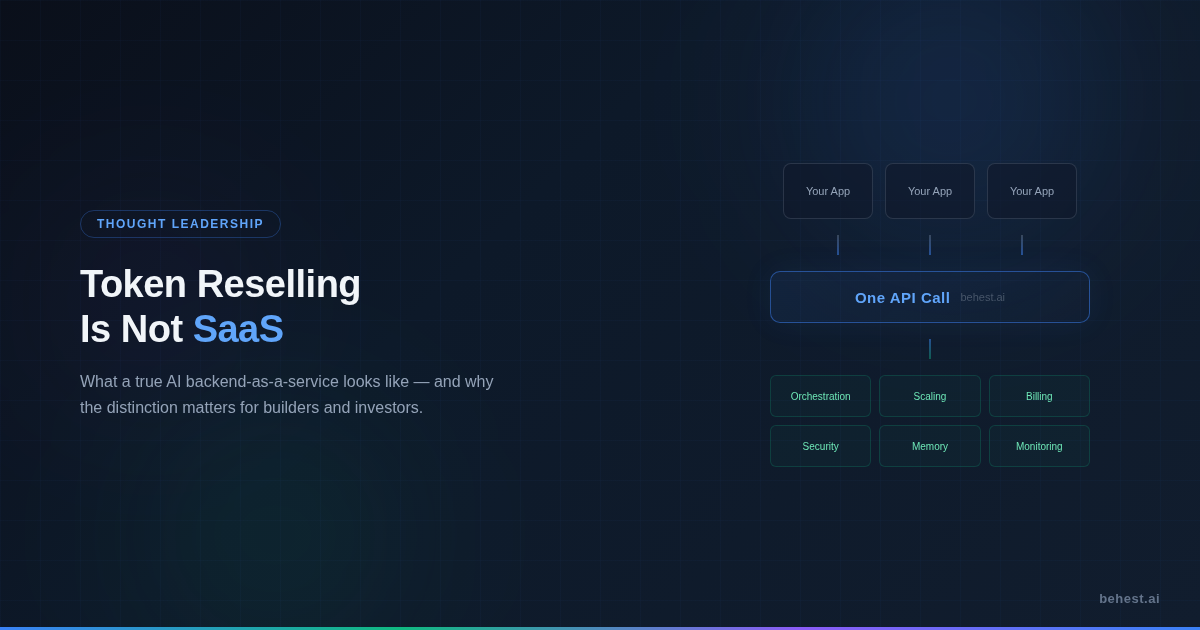
The token reselling problem
When your entire business model is buying tokens at wholesale and selling them at retail, you don't have a software company. You have a margin business with no defensibility, no switching costs, and no real value creation. The moment your model provider drops their price — or your customer realizes they can call the same API directly — your business evaporates.
The market is starting to notice. Investors are asking harder questions about gross margins, unit economics, and what happens when model prices continue their downward trend. And the answer, for token resellers, is uncomfortable.
What real AI SaaS looks like
A true SaaS model in the age of AI looks fundamentally different. It's not about reselling access to a model. It's about delivering infrastructure that customers cannot easily build themselves — and that becomes more valuable over time.
At Behest AI, we built the opposite of a token reseller. We are an AI backend-as-a-service. When a customer makes a single API call to Behest, they get a complete production backend: model orchestration across multiple providers, auto-scaling, rate limiting, persistent memory, usage tracking, built-in billing and monetization, security, and observability. The customer builds only the front end. We handle everything behind it.
We don't mark up tokens. We don't care which model you use — OpenAI, Anthropic, Google, open-source. Our value isn't in the model layer. Our value is in the infrastructure layer that sits between your application and the models, the layer that turns a raw API call into a production-grade AI product.
This is the same pattern that built the most enduring infrastructure companies of the last decade. Stripe doesn't process payments by marking up Visa's interchange fees. Twilio doesn't resell AT&T minutes. They built platforms that abstract away complexity and let developers ship faster. That's real SaaS.
Why the distinction matters
For builders, the difference is practical. If your "platform" is just a token proxy, you're one API key away from being cut out. Your customers have no switching costs. Your margins compress every time a model provider adjusts pricing. You're building on sand.
A real backend platform creates genuine lock-in — not through contracts, but through value. When a customer's billing logic, usage analytics, scaling configuration, and multi-model routing all run through your infrastructure, migration means rebuilding months of work. That's a real business.
For investors, the distinction is even more critical. Token reselling produces revenue that looks like SaaS but behaves like a commodity business. Gross margins are thin and unpredictable. Customer retention depends entirely on price, not product. There's no compounding advantage.
True AI infrastructure SaaS has the economics investors actually want: high gross margins, strong net revenue retention, and natural expansion as customers grow. Revenue scales with customer success, not with token volume.
The standard we hold ourselves to
We built Behest AI around a simple principle: one API call should give you a complete AI backend. Not a token. Not a proxy. A production-ready backend with everything your application needs to serve real users at scale.
We are model-agnostic by design. We will never lock customers into a single provider or profit from token arbitrage. Our business grows when our customers ship better AI products faster — not when they consume more tokens.
The AI industry is maturing. The companies that will endure are the ones building real platforms with real infrastructure and real value creation. Token reselling had its moment. The market is ready for something better.
See it on your own numbers
Put your AI spend under control
Book a 15-minute walkthrough and see how Behest attributes, budgets, and enforces every model call — before the invoice arrives.