
Build a Full AI App in a Weekend — Lovable for the Frontend, Behest for the Backend
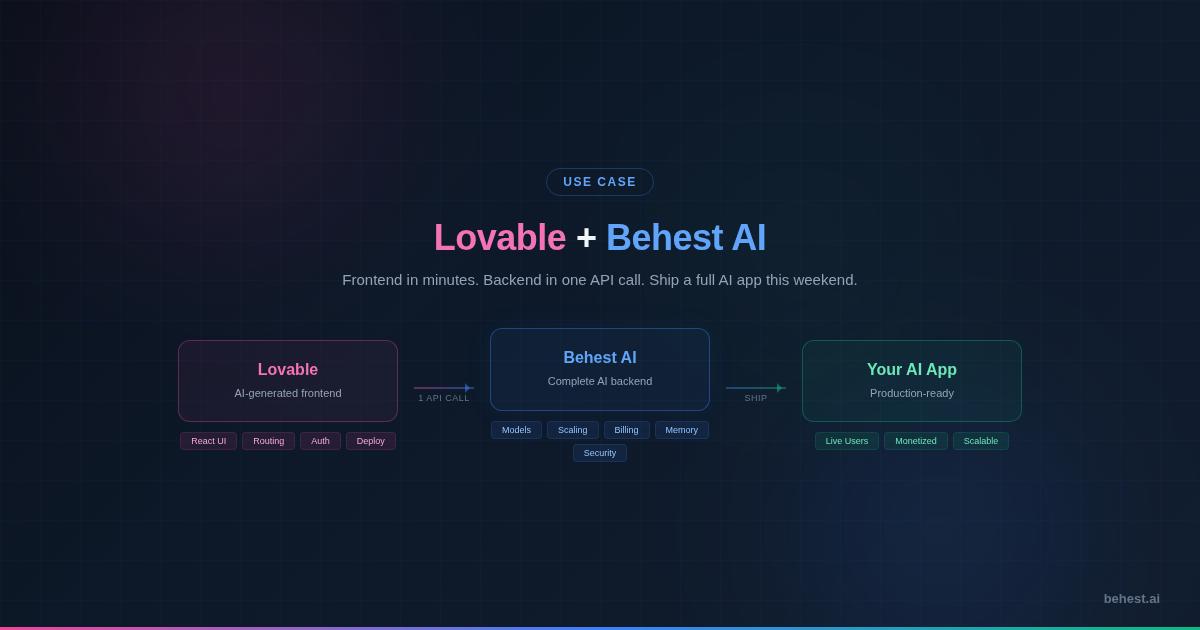
You can build a complete AI-powered application this weekend. No backend team. No infrastructure. No months of setup. Just two tools and an idea.
Here's how.
The stack
Behest AI is an AI backend-as-a-service. One API call gives your app a complete production backend: model orchestration across OpenAI, Anthropic, Google, and open-source models, plus auto-scaling, persistent memory, rate limiting, usage tracking, and built-in billing. No backend code required.
A real example: AI customer support app
Let's walk through building an AI-powered customer support tool — the kind that would normally take a team of 3-4 engineers several months.
Open Lovable and describe your app: "A customer support dashboard where users type questions and get AI-powered answers. Include a conversation history sidebar, a main chat window, and a settings page where admins can customize the AI's personality and tone."
Step 2: Connect the AI backend with Behest
Sign up at dashboard.behest.ai and grab your API key. In your Lovable app, point your chat component at the Behest API.
Send the user's message, get back an AI response. That's it. Behind that single call, Behest is handling model selection, conversation memory, rate limiting, and scaling. Your app now has a production-grade AI backend.
Use Behest's system prompts to define your support agent's behavior: "You are a helpful customer support agent for [Company]. Be concise, friendly, and always offer to escalate to a human if you can't resolve the issue." Set rate limits so no single user can abuse the system. Turn on usage tracking so you can see how your app is being used.
Deploy through Lovable. You now have a live AI customer support tool.
Total time: a weekend. Total backend code written: zero.
Why this combination works
The AI application space has a gap. Tools like Lovable have made it remarkably easy to build frontends — what used to take weeks now takes hours. But every AI app still needs a backend, and that's where most projects stall. Teams spend months building model integrations, scaling infrastructure, billing systems, and monitoring dashboards before a single user sees the product.
Behest fills that gap. Instead of building the backend, you connect to it. Lovable builds the house. Behest provides the plumbing, electrical, and foundation.
This matters because the barrier to building AI products has shifted. It's no longer "can you build a UI?" — tools like Lovable solved that. The question is "can you build and maintain the AI infrastructure behind it?" For most teams, the honest answer is: not quickly, not cheaply, and not without hiring specialized engineers.
What you can build
This pattern — Lovable frontend + Behest backend — works for any AI application:
In every case, the pattern is the same: Lovable for what users see, Behest for what makes it work.
The era of needing a full engineering team to launch an AI product is over. The tools exist. The only question is what you're going to build.
Behest AI is an AI backend-as-a-service. One API call. Full production backend. behest.ai
See it on your own numbers
Put your AI spend under control
Book a 15-minute walkthrough and see how Behest attributes, budgets, and enforces every model call — before the invoice arrives.