
Why Most FinOps Programs Fail: Tracking Infrastructure Instead of Business Value
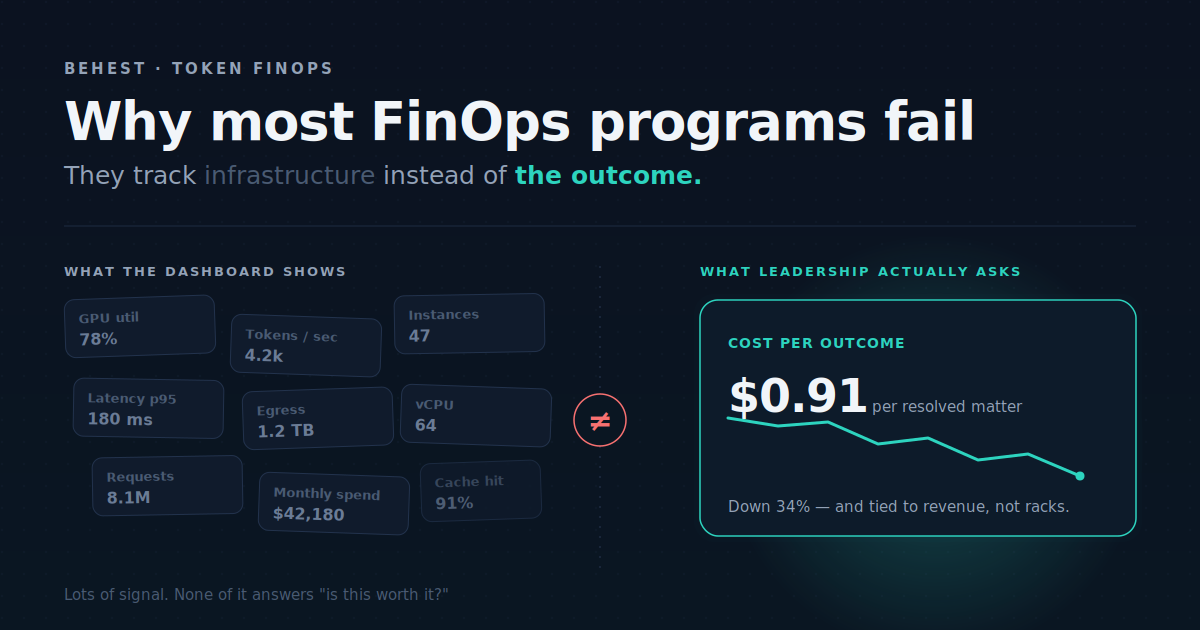
For years, FinOps teams focused on a simple question:
How much are we spending?
Cost management tools helped answer that question by providing visibility into infrastructure costs, reserved instance utilization, Kubernetes spend, and cloud waste.
But in 2026, a different question is becoming far more important:
What business outcome did this spend create?
And for many organizations, that's where FinOps breaks down.
The problem isn't visibility anymore.
The problem is attribution.
The Allocation Problem
Across the FinOps community, practitioners are increasingly questioning whether perfect cost allocation is even possible in modern environments.
Shared services, Kubernetes clusters, AI workloads, serverless functions, and distributed architectures make it difficult to answer a seemingly simple question:
Who owns this cost?
Many teams spend months building allocation models only to discover that achieving 100% accuracy is nearly impossible.
As one recent FinOps discussion noted, organizations often get the best results by focusing on allocations that are "accurate enough to drive the right behavior" rather than chasing perfect precision. Finance wants predictability. Engineering wants consistency. Neither benefits from allocation models that require constant maintenance.
The challenge becomes even more difficult once AI enters the picture.
AI Broke Traditional FinOps
Traditional cloud infrastructure has relatively clear boundaries.
You can allocate the following to teams, projects, or cost centers.:
- Compute resources
- Storage
- Databases
- Containers
- Kubernetes clusters
Generative AI introduces an entirely different cost structure.
Now organizations must account for:
- Tokens
- Inference requests
- Agent workflows
- Embeddings
- Fine-tuning jobs
- Shared AI infrastructure
A monthly provider invoice might tell you that you spent $250,000 on AI.
But it will be missing:
- Which product generated the spend
- Which department consumed the budget
- Which feature drove the costs
- Which users created the demand
- Whether the spend generated positive ROI
The invoice shows spending. It doesn't show ownership.
The New FinOps Metric: Cost Per Business Outcome
The most mature FinOps organizations are moving beyond infrastructure reporting and toward business-level attribution.
Instead of measuring:
- Cost per VM
- Cost per cluster
- Cost per database
they measure:
- Cost per customer
- Cost per feature
- Cost per workflow
- Cost per support ticket
- Cost per AI interaction
- Cost per generated report
This shift changes the conversation.
Instead of asking:
Why did AI spend increase 40%?
Organizations can ask:
Which product feature generated that spend, and was it profitable?
That's the difference between cost visibility and cost accountability. Understanding your ROI.
Why Tagging Isn't Enough
Many organizations assume better tagging policies will solve attribution problems.
Unfortunately, reality is messier.
Anyone who has managed cloud environments at scale has encountered:
- Missing tags
- Incorrect tags
- Shared infrastructure
- Cross-functional teams
- Shadow IT
- Temporary workloads that become permanent
A recent Azure discussion highlighted how a single forgotten GPU cluster caused significant attribution confusion because ownership and cost-center mapping were unclear.
Tagging remains necessary.
But tagging is not attribution.
Attribution requires understanding how infrastructure, applications, users, and business outcomes connect.
AI Costs Are Becoming a Board-Level Problem
Many organizations are now spending six or seven figures annually on AI APIs. Yet finance teams still receive invoices that provide little operational context. Recent discussions among FinOps practitioners reveal a common pattern:
Teams know what they're spending.
They don't know why they're spending it.
Without attribution, organizations struggle to answer critical questions:
- Which department owns AI costs?
- Which application consumes the most tokens?
- Which users generate the highest spend?
- Which features produce measurable business value?
- Which AI initiatives should receive additional investment?
This creates tension between finance and engineering.
Engineering sees innovation.
Finance sees an expanding invoice.
Neither side has a shared source of truth.
Token FinOps Emerges
Traditional FinOps was built for cloud infrastructure. Generative AI requires a new operating model. This is where Token FinOps enters.
Token FinOps extends FinOps principles into AI workloads by treating every AI request as a measurable business event rather than an opaque infrastructure expense. According to Behest, Token FinOps provides request-level visibility that attributes costs by user, project, session, team, and cost center rather than aggregating everything into a single monthly invoice.
Instead of receiving a bill that says:
AI Spend: $250,000
organizations can understand:
- Which department spent the money
- Which application generated the requests
- Which user initiated the activity
- Which model was used
- Which business workflow consumed the tokens
That changes FinOps from reporting to governance.
How Behest Solves the Attribution Problem
Behest AI approaches the problem differently than traditional cloud FinOps platforms.
Rather than analyzing costs after invoices arrive, Behest sits directly in the AI request path and records spending at the session, user, project, and cost-center level. This creates finance-ready records for every AI interaction while enabling budget enforcement before costs spiral out of control.
With Behest, organizations can:
- Attribute AI costs to individual departments
- Allocate spend to projects and cost centers
- Track employee-level AI usage
- Enforce hard spending limits
- Create chargeback and showback models
- Forecast AI budgets more accurately
- Maintain governance and audit trails
Instead of discovering overruns at the end of the month, teams can identify spending anomalies in real time.
The Future of FinOps
The next generation of FinOps won't be defined by better dashboards.
It will be defined by better attribution.
The organizations that succeed won't necessarily spend less.
They'll simply know:
- What they spent
- Who spent it
- Why they spent it
- What value it created
Infrastructure-level visibility solved yesterday's problem.
Business-level attribution solves tomorrow's.
As AI becomes embedded into every workflow, feature, and product, the companies that can connect spend directly to outcomes will have a significant competitive advantage.
The future of FinOps is not cost optimization.
It's cost accountability.
And accountability starts with attribution.
See it on your own numbers
Put your AI spend under control
Book a 15-minute walkthrough and see how Behest attributes, budgets, and enforces every model call — before the invoice arrives.